
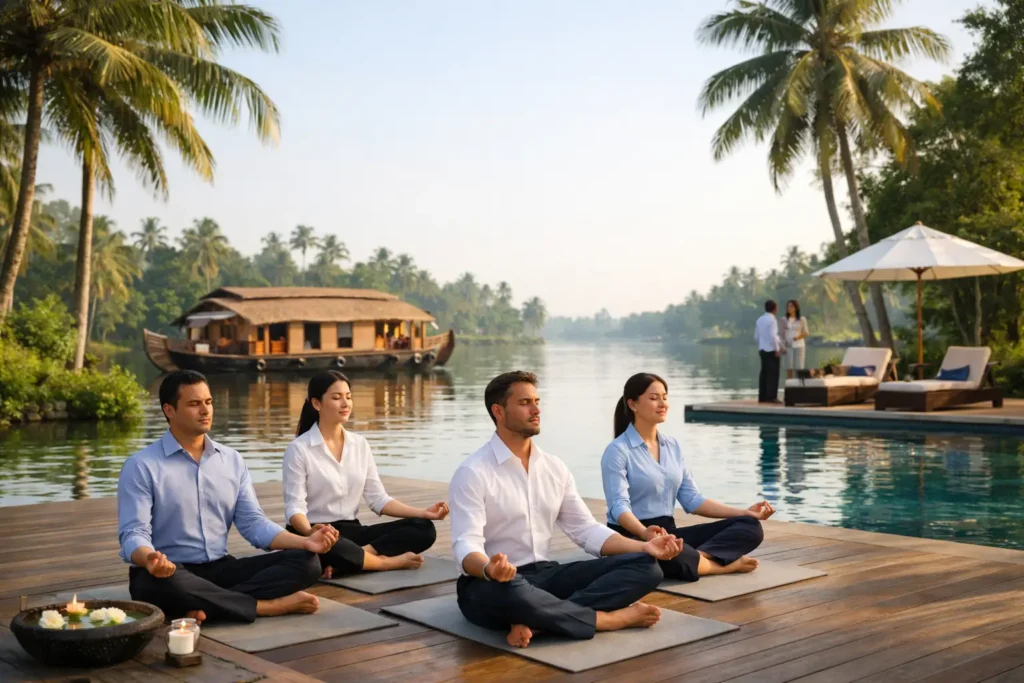
A tired team does not need another hotel ballroom, another slide deck, or another forced bonding exercise. What many companies need instead is a corporate wellness retreat Kerala can uniquely offer – one grounded in Ayurveda, yoga, nature, and real recovery rather than surface-level perks.
Kerala has long been recognized as one of India’s most credible destinations for Ayurvedic healing. For corporate groups, that matters. When stress shows up as poor sleep, irritability, low focus, and rising absenteeism, a retreat should do more than create a pleasant break. It should help people regulate their nervous systems, reset habits, and return with more steadiness than they had before they arrived.
Why Kerala works for corporate wellness
Not every retreat destination can support both restoration and structure. Kerala can. The setting itself helps – coastal air, backwaters, tropical greenery, and a slower rhythm that immediately contrasts with high-pressure work culture. But the deeper advantage is its wellness infrastructure.
In Kerala, Ayurveda is not presented as a trend. It is a living medical tradition supported by trained doctors, licensed therapists, established retreat centers, and treatment protocols that can be adapted to different constitutions and health goals. That makes the experience especially valuable for international corporate groups who want authenticity but also need professional standards, clear planning, and dependable care.
Yoga also fits naturally into a corporate retreat here because it can be scaled to the group. A team may include experienced practitioners, complete beginners, high performers dealing with burnout, and travelers who simply want rest. In the right retreat setting, yoga is not treated as performance. It becomes a practical tool for mobility, breath regulation, better sleep, and mental clarity.
What a corporate wellness retreat Kerala experience should include
A strong retreat is never just a beautiful property with a few wellness activities added on. For companies investing in employee well-being, the design of the program matters as much as the location.
The most effective retreats begin with personalization. That may include pre-arrival health forms, consultations with Ayurvedic doctors, and a schedule that accounts for energy levels, dietary needs, and the group’s reason for traveling. Some teams want stress recovery and gentle restoration. Others want a deeper reset with detox support, Panchakarma-inspired therapies, yoga, meditation, and healthier daily rhythms.
Treatment quality matters as well. Abhyanga massage, herbal therapies, steam treatments, stress-relief protocols, and guided relaxation can all support recovery, but only when supervised appropriately. A corporate group does not need an extreme or highly rigid program to benefit. In fact, for many organizations, a moderate schedule works best – enough structure to create measurable value, with enough spaciousness for integration.
Food is another part of the experience that is often underestimated. Fresh Ayurvedic meals, prepared according to body type and retreat goals, can noticeably affect digestion, energy, and mood within a short stay. For professionals accustomed to caffeine-heavy days, late dinners, and rushed meals, simply eating in a calmer and more intentional way can feel transformative.
The real business case for sending teams to Kerala
There is a practical reason more leadership teams are looking beyond standard offsites. Burnout is expensive. So is disengagement, emotional fatigue, and a workplace culture where people are always functioning in reaction mode.
A well-designed retreat can support outcomes that matter back at work: clearer thinking, better emotional regulation, stronger team connection, and reduced stress load. That does not mean a retreat becomes a cure-all. It does not replace good management, healthy boundaries, or realistic workloads. But it can create the kind of interruption many professionals need in order to notice how depleted they have become.
Kerala is especially well suited to this because the retreat model can blend individual healing with group experience. A company can schedule private consultations and therapies during the day, then bring the team together for meditation, shared meals, reflection circles, or gentle movement sessions. That balance often works better than a packed agenda of mandatory group activities.
There is also a signaling effect. When a company chooses a retreat centered on genuine well-being rather than optics, employees notice. It communicates care in a more credible way. Not as a slogan, but as a tangible investment in human recovery.
How to plan the right corporate wellness retreat in Kerala
The first question is not where to go. It is why the group is going. Some retreats are best built around executive stress recovery. Others are ideal for post-project decompression, leadership renewal, women’s wellness groups, or values-driven team connection. The purpose shapes everything else, from length of stay to treatment intensity.
Trip duration matters more than many planners expect. A two- or three-night retreat can be refreshing, but it usually functions as a reset rather than a deep healing program. A five- to seven-night stay gives enough time for consultations, therapies, yoga practice, rest, and adjustment to a slower pace. For teams traveling from the US, the longer format often delivers better value because it justifies the travel time and allows the body to settle.
The property itself should also fit the group. Some teams prefer a quiet beachfront environment. Others feel more supported in a backwater or garden setting with a stronger clinical Ayurveda focus. Luxury matters, but in this category, luxury should mean calm service, privacy, beautiful surroundings, clean accommodations, skilled practitioners, and thoughtful logistics – not excess for its own sake.
Medical credibility is non-negotiable. Look for retreats with certified Ayurvedic doctors, trained therapists, clear treatment protocols, and recognized standards. This is particularly important for international guests who may be new to Ayurveda and want reassurance that care is both authentic and responsibly delivered.
Then there is logistics. Airport transfers, rooming coordination, meal preferences, scheduling, and on-ground support can determine whether a retreat feels restorative or chaotic. This is where experienced retreat curation becomes valuable. Companies do not just need a venue. They need a partner who can shape the flow of the experience from arrival to departure.
What different teams may need
No two corporate groups arrive with the same needs, and that is where customization becomes essential. A senior leadership team may need privacy, executive coaching elements, and a highly refined schedule with one-on-one therapies. A broader employee wellness group may benefit from a more accessible mix of yoga, meditation, stress-relief treatments, nutritious meals, and flexible downtime.
For some organizations, introducing Ayurveda gently is the right move. That might mean consultations, simple therapies, and daily yoga without committing to a full Panchakarma program. For others, especially smaller private groups seeking a more profound reset, a deeper healing format may be appropriate.
It also depends on company culture. If participants are skeptical or completely new to wellness travel, the retreat should be welcoming and practical, not overly esoteric. If the group is already wellness-oriented, there may be room for a richer program with meditation, philosophy, detox support, and more immersive healing work.
Choosing a retreat partner matters
The difference between a memorable retreat and a disappointing one often comes down to curation. Kerala offers exceptional possibilities, but not every property is right for every group, and not every beautiful setting delivers strong therapeutic care.
A carefully curated provider such as AYUR YOGA can help match group goals with accredited retreat properties, certified doctors, suitable treatment plans, and the right level of comfort and structure. That matters because corporate retreat planning has more moving parts than leisure travel. Budget, privacy, health considerations, travel fatigue, group dynamics, and expectations all need to be balanced with care.
The best retreat partners do not force every group into the same package. They build around the team – adjusting the pace, therapies, meal plans, yoga level, and support systems so the experience feels precise rather than generic.
A retreat people actually remember
People rarely remember the meeting agenda from an offsite six months later. They do remember how they felt. They remember sleeping deeply for the first time in months, breathing without pressure in their chest, eating well, thinking clearly, and speaking to colleagues as human beings instead of job titles.
That is the quiet power of a corporate wellness retreat Kerala can deliver with integrity. Not spectacle, but restoration. Not corporate theater, but a grounded return to balance.
If your team needs more than a break, choose a retreat that gives them space to heal, rebalance, and return stronger than they left.