
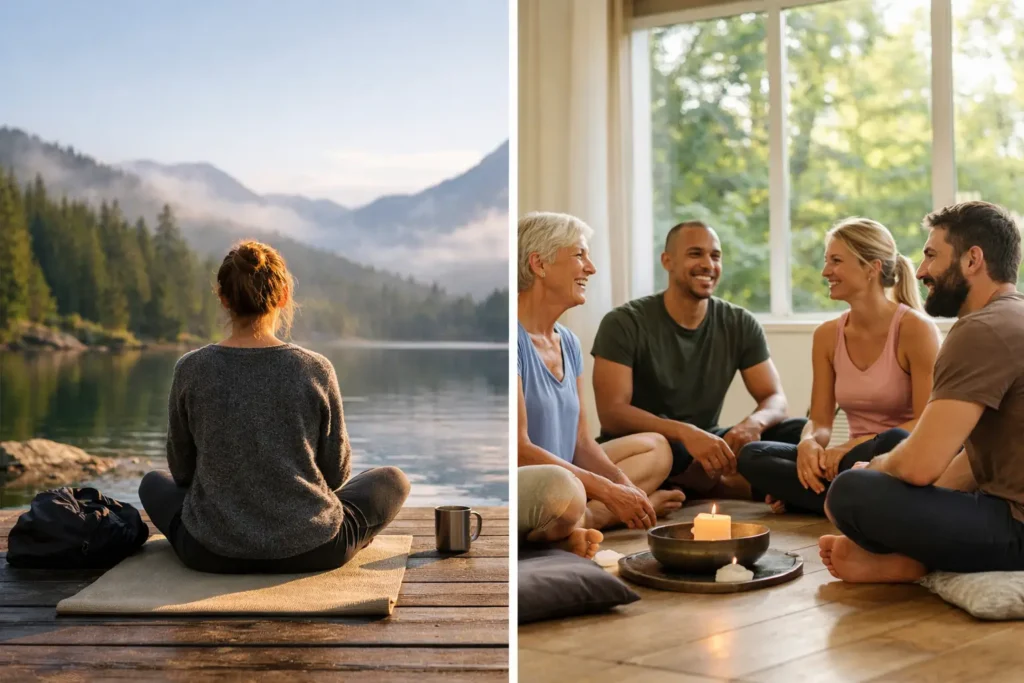
Some guests arrive in Kerala knowing exactly what they need. They want silence, a structured healing plan, and space to finally hear themselves think. Others feel called to share the experience with a partner, a close friend, or a like-minded group. If you are deciding between a solo retreat or group retreat, the right choice is less about what sounds appealing on paper and more about how you want to heal.
In wellness travel, the most meaningful results often come from alignment. Your retreat format should support your nervous system, your energy levels, your emotional needs, and your reason for traveling. Ayurveda has always honored individuality, so it makes sense that the best retreat experience is not one-size-fits-all.
How to choose between a solo retreat or group retreat
A retreat is not simply a vacation with yoga classes added in. In an authentic Kerala setting, it can include Ayurvedic consultations, body therapies, meditation, therapeutic meals, rest periods, and a daily rhythm designed to rebalance the body and mind. That structure affects you differently depending on whether you move through it alone or with others.
A solo retreat often feels more inward. It gives you privacy, autonomy, and a chance to settle into your own pace without adapting to anyone else. This can be especially supportive if you are recovering from burnout, emotional fatigue, decision overload, or prolonged stress. Many professionals and caregivers choose solo wellness travel because they spend so much of life responding to others. Retreat becomes the first place in a long time where nothing is asked of them.
A group retreat offers a different kind of medicine. Shared practice can create warmth, accountability, and emotional safety. For some guests, healing happens more easily in community. Group energy can make it easier to stay engaged with yoga, open up during reflective moments, and feel supported through lifestyle changes. If you have been feeling isolated, disconnected, or stuck in routines that are hard to shift alone, a group setting may help you re-enter yourself through connection.
Neither option is inherently better. The better question is this: what environment will help you soften, trust the process, and stay present long enough for real change to begin?
When a solo retreat is the better choice
A solo retreat is often ideal when your primary goal is personal restoration. If your system feels overextended, even low-pressure social interaction may feel like one demand too many. In that state, the luxury is not entertainment. It is relief. Private space, personalized treatment timing, quiet meals, and uninterrupted rest can become deeply therapeutic.
This format also works well for guests coming for more targeted Ayurvedic care. If you are planning Panchakarma, stress-recovery treatments, digestive reset work, sleep support, or hormonal balancing, you may want a retreat environment centered around your body’s needs rather than the rhythm of a group. One-to-one consultations with certified Ayurvedic doctors, individualized therapies, and customized meals often feel more integrated in a solo format.
There is also an emotional layer. Traveling alone can be surprisingly clarifying. Without familiar roles and social habits, many guests notice how much of their energy has been shaped by expectation. A solo retreat creates room to observe your patterns with honesty. You may discover that what looked like exhaustion was grief, that what felt like lack of discipline was actually depletion, or that what you needed was not motivation but nervous system regulation.
That said, solo retreats are not always easy at first. Silence can bring up restlessness. Spaciousness can reveal emotions you have kept busy enough to avoid. If you are new to retreat travel, this intensity may feel unfamiliar. It helps when the experience is professionally held, with a clear daily structure, trusted therapists, and on-ground support that allows you to relax without feeling alone.
Best fit for a solo retreat
A solo retreat often suits guests who are experiencing burnout, seeking deep rest, wanting private Ayurvedic care, moving through a life transition, or simply craving stillness more than stimulation.
When a group retreat makes more sense
A group retreat can be deeply restorative in its own way, especially when the group is intentional and the program is well curated. Many guests do better when healing includes connection. Practicing yoga in a shared shala, enjoying nourishing meals together, and having others witness your process can create a gentle sense of belonging.
This format is especially appealing for friends traveling together, couples, women’s circles, wellness communities, and corporate teams looking for meaningful reset experiences. It can also be helpful if you are curious about yoga or Ayurveda but feel more comfortable entering that world with guidance and companionship. A shared retreat softens the learning curve.
There is practical value too. Groups often benefit from a sense of rhythm and momentum. It is easier to show up for morning meditation when others are walking the same path. Conversations after treatment or class can turn insight into action. In many cases, guests leave not only refreshed but also more committed to healthier habits because the experience felt supported rather than solitary.
Still, group retreats involve compromise. Your schedule may be more structured around collective activities. Social energy, even in a peaceful setting, can sometimes feel tiring if you are highly sensitive or already depleted. And while shared experiences can be uplifting, they can also distract from inner work if the group dynamic is too active or externally focused.
The quality of the group design matters. A well-led retreat should preserve personal space while offering meaningful moments of community. The most healing group experiences do not crowd the guest. They hold them.
Best fit for a group retreat
A group retreat often suits guests who feel energized by community, want shared motivation, are traveling with loved ones, or prefer guided wellness experiences with a built-in sense of connection.
What matters more than the format
The solo-versus-group question is important, but it is not the only one. The deeper difference in outcomes usually comes from how thoughtfully the retreat is designed.
A solo retreat without clinical depth may feel peaceful but not transformative. A group retreat without skilled facilitation may feel busy rather than restorative. What truly supports healing is the combination of qualified Ayurvedic oversight, an appropriate treatment plan, quality accommodations, balanced scheduling, nourishing food, and enough care around logistics that your mind can finally settle.
This is especially true for international travelers coming to India for wellness. Authenticity matters, but so does reassurance. You want traditional Ayurvedic integrity, certified practitioners, and retreat infrastructure that feels safe and organized from arrival onward. When those pieces are in place, both solo and group formats can be exceptional.
At AYUR YOGA, this is why customization matters so much. Some guests need a deeply private healing journey with personalized therapies and minimal interaction. Others want a beautifully organized shared retreat with daily yoga, meditation, Ayurvedic treatments, and the comfort of traveling with their chosen circle. The strongest retreat design starts by listening before prescribing.
A simple way to decide
If you are torn between the two, start with your current state, not your ideal self. Ask yourself what you need at this moment to heal, rebalance, and renew.
If you feel overstimulated, emotionally thin, physically tired, or resistant to more conversation, a solo retreat may offer the exhale your system has been asking for. If you feel lonely, unmotivated, uncertain, or encouraged by shared experience, a group retreat may be more nourishing.
You can also think in terms of your intention. If your retreat is about treatment, recovery, and personal reflection, solo often works beautifully. If your retreat is about connection, learning, celebration, or collective reset, group may be the stronger fit. Some travelers even benefit from a hybrid approach, with private consultations and treatments alongside selected group practices.
The most luxurious retreat is not the one with the longest treatment menu or the most photogenic setting. It is the one that meets you accurately.
A well-chosen retreat format can change the quality of your experience from pleasant to profound. Whether you travel alone or with others, the real goal is the same – to enter an environment where your body can soften, your mind can quiet, and your deeper vitality has room to return.