
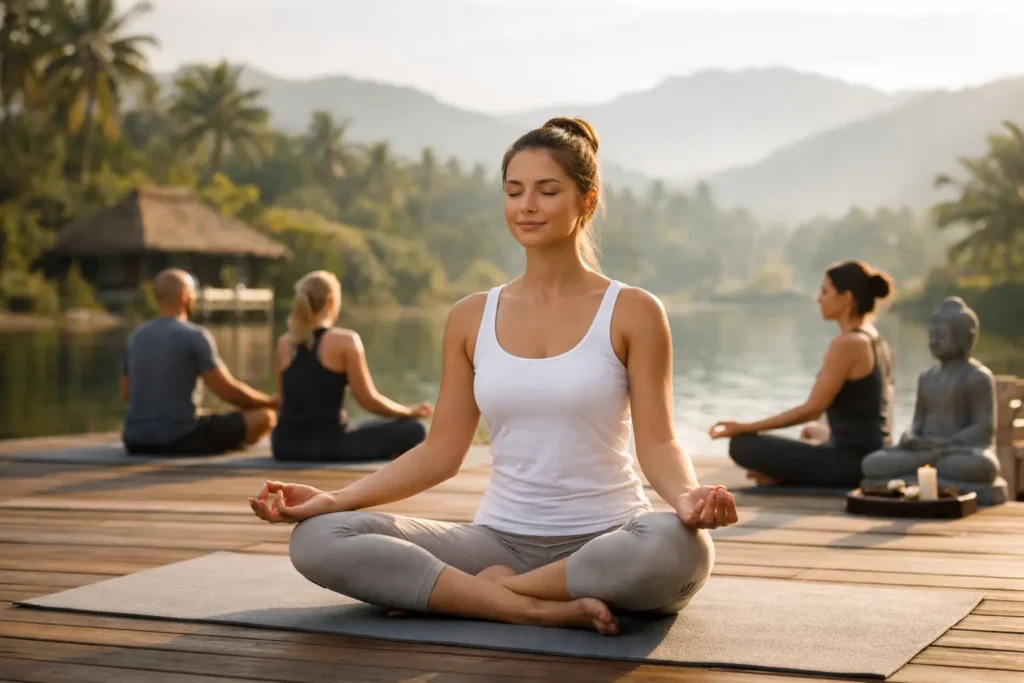
A daily yoga meditation retreat is often less about doing more and more about finally hearing yourself again. Many guests arrive in Kerala carrying the familiar signs of modern strain – light sleep, mental fatigue, physical stiffness, emotional overload, and the quiet feeling that something essential has been pushed aside for too long. What changes in retreat is not only the schedule. It is the quality of attention you receive, the rhythm you live in, and the way the body begins to trust rest again.
For wellness travelers, this kind of retreat can feel deceptively simple. You wake early, move gently, breathe with intention, meditate, eat clean food, and receive therapies designed to support your system rather than stimulate it. Yet when these practices are delivered consistently in the right environment, the effect is profound. A well-designed retreat does not chase quick fixes. It creates conditions for healing, rebalancing, and renewal.
What makes a daily yoga meditation retreat different
The difference lies in continuity. At home, even the most committed wellness routine competes with work, devices, family obligations, and decision fatigue. In retreat, the day is structured for recovery. You are not trying to fit calm into a crowded schedule. Calm becomes the schedule.
That distinction matters. Daily yoga and meditation practiced in a peaceful setting can regulate the nervous system more effectively than occasional sessions squeezed into a busy week. The body responds well to repetition, especially when it is paired with nourishing meals, steady sleep times, quiet surroundings, and expert guidance. Instead of feeling like a wellness activity, practice becomes an experience of internal order.
In Kerala, this experience also carries cultural depth. Yoga and meditation are not presented as trends or performance disciplines. They are part of a broader healing tradition that values balance, awareness, digestion, rest, and the connection between mind and body. When paired with authentic Ayurveda, the retreat experience becomes even more personal.
Why Kerala is ideal for a daily yoga meditation retreat
Kerala offers something many wellness destinations cannot replicate – an atmosphere that naturally supports restoration. The climate, greenery, slower pace, and strong Ayurvedic heritage all contribute to a sense of ease. From backwater landscapes to peaceful coastal settings, the environment itself encourages the exhale many guests have been postponing.
Just as important, Kerala is one of the few places where yoga, meditation, and Ayurveda can be experienced together in a way that feels integrated rather than packaged. A morning yoga class, a guided meditation, a consultation with an Ayurvedic doctor, and a therapeutic treatment in the afternoon are not separate wellness add-ons. They are parts of a coherent system.
For international travelers, that coherence is reassuring. You are not left to assemble your own healing plan. Experienced practitioners can help shape a daily rhythm based on your needs, whether your primary goal is stress recovery, better sleep, digestive balance, emotional clarity, or simply time to reconnect with yourself.
A typical day on a daily yoga meditation retreat
The beauty of a retreat day is that it feels spacious without being empty. Mornings often begin early, when the atmosphere is still and the mind is more receptive. Gentle yoga may focus on mobility, breath, and circulation rather than intensity. This is especially important for guests arriving with exhaustion, jet lag, chronic stress, or long periods of sedentary work.
Meditation usually follows or is woven into the morning practice. For some guests, this becomes the most meaningful part of the day. Not because every session feels perfectly peaceful, but because daily practice begins to soften the constant inner noise. Over several days, many people notice improved concentration, steadier emotions, and a more grounded response to stress.
Meals are another part of the healing structure. Fresh, balanced food prepared with wellness in mind supports digestion and energy without heaviness. In Ayurvedic settings, meals may also be aligned with your constitution or current imbalance, which adds a layer of personalization many travelers have never experienced before.
Afternoons often include Ayurvedic treatments, rest, or quiet time. This is where the retreat differs sharply from an active vacation. There is space to absorb rather than consume. Some guests initially find this unfamiliar. Then they realize how rarely they allow themselves to be still without guilt.
Evenings tend to be calm, with lighter movement, meditation, reflection, or simply early rest. It may sound modest on paper, but when repeated daily, this rhythm can reset patterns that have felt stubborn for years.
The real benefits guests notice
The most immediate benefit is often a change in the nervous system. Guests who arrive feeling wired and tired frequently report deeper sleep, slower breathing, fewer racing thoughts, and a noticeable drop in internal tension within days. This is not magic. It is the result of consistent practices, reduced stimulation, and an environment designed for recovery.
Physical changes often follow. Regular yoga can improve flexibility, posture, joint mobility, and circulation. Meditation can reduce mental clutter and help people respond to stress with more awareness. When Ayurveda is part of the program, guests may also experience improvements in digestion, energy, skin health, and overall vitality, depending on their condition and treatment plan.
There are emotional benefits too, and these are often underestimated. A retreat creates enough quiet for people to notice what they have been carrying. Sometimes that leads to relief. Sometimes it brings up fatigue or emotion before things feel lighter. That is normal. Real restoration is not always instant, and a quality retreat makes room for that process with compassionate support.
Is a daily yoga meditation retreat right for everyone?
Usually, yes – but the best format depends on your starting point. If you are deeply burned out, an intense retreat with multiple strong yoga classes each day may not be what your system needs. In that case, a gentler program with restorative movement, meditation, therapeutic treatments, and more rest is often more effective.
If you already have a strong yoga practice, you may want deeper instruction and more structured sessions. If you are completely new, you need skilled teachers who can adapt without making the experience feel watered down. The same is true for meditation. Some guests want silence and discipline. Others benefit more from guided practices and gradual introduction.
This is why personalization matters. The most successful retreats are not built around a fixed ideal guest. They are shaped around the actual person arriving.
Choosing the right retreat experience
A beautiful setting matters, but it should not be the main decision point. The quality of practitioners, the authenticity of the wellness program, and the level of personalized care are far more important. Ask whether yoga is adapted for different levels, whether meditation is guided by experienced teachers, and whether Ayurvedic consultations and treatments are delivered by qualified professionals.
It is also worth looking at how the retreat supports the full journey. International guests often feel most at ease when accommodations, meals, wellness scheduling, airport transfers, and local coordination are handled smoothly. Quiet luxury in wellness travel is not excess. It is the confidence that every detail has been thoughtfully managed so you can focus on healing.
This is where carefully curated Kerala experiences stand apart. When a retreat is designed with both authenticity and hospitality in mind, guests can let go more fully. AyurYoga Retreats, for example, reflects this approach by combining traditional wellness expertise with reliable travel support and personalized retreat planning.
What to expect after you return home
A retreat does not create lasting change by keeping you away from life. Its value is in how you return to life. After several days of daily practice, many guests find they no longer want to go back to constant overstimulation. They sleep earlier, eat more mindfully, move with greater awareness, and protect quiet time with new seriousness.
That said, not every benefit remains automatically. Some effects deepen only if you continue even a small portion of what you learned. Ten minutes of morning breathing, a short meditation, or a gentler evening routine can preserve far more than people expect. The goal is not to recreate a retreat perfectly at home. It is to carry its intelligence into your everyday rhythm.
A daily yoga meditation retreat offers something rare: a structured pause that is both nurturing and transformative. When guided well, it can help you feel clearer in your mind, lighter in your body, and more at home in yourself. Sometimes that is exactly where true healing begins.