
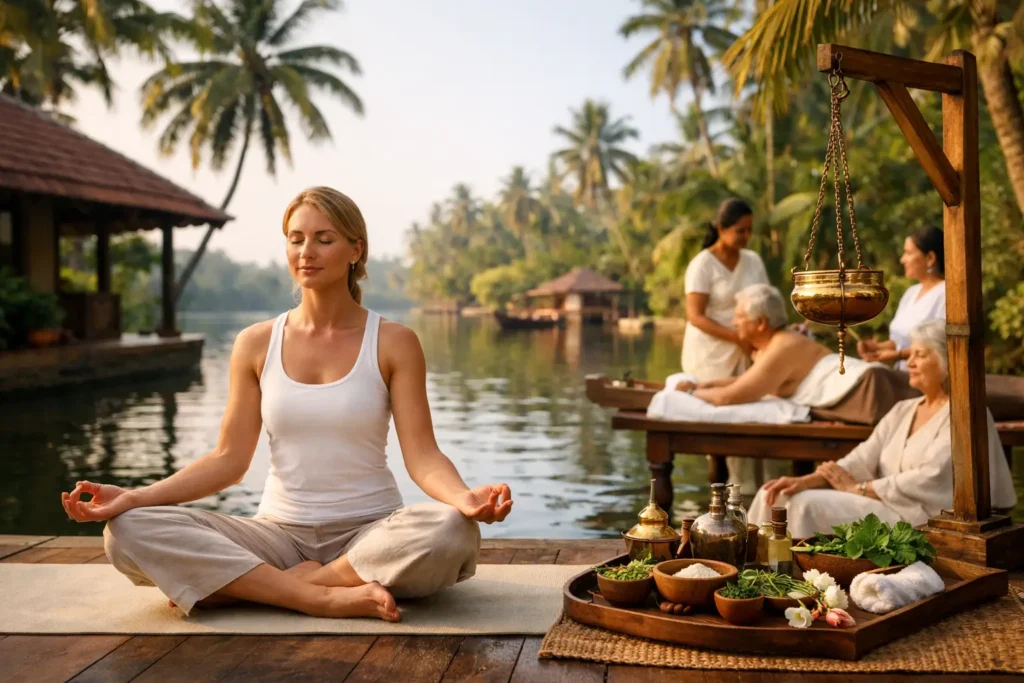
A retreat can feel very different when your morning yoga practice, meals, treatments, rest, and guidance all support the same intention. The best Yoga Ayurveda combinations are not simply a yoga class followed by a massage. They are thoughtfully paced experiences that help you slow down, reconnect with your body, and carry a steadier sense of balance home.
For international travelers, Kerala offers a particularly meaningful setting for this approach. Here, yoga and Ayurveda are practiced as complementary traditions: yoga cultivates awareness through movement, breath, and meditation, while Ayurveda considers daily rhythms, nourishment, therapeutic care, and individual constitution. Together, they can create a restorative wellness holiday that feels both deeply personal and beautifully organized.
Why Yoga and Ayurveda Belong Together
Yoga asks us to observe. Through asana, breathwork, and meditation, we notice where effort has become strain, where the mind is restless, and what the body needs to feel more at ease. Ayurveda brings that awareness into the rest of the day. It considers how sleep, food, climate, activity, and treatment choices may support overall well-being.
The combination works best when neither practice is treated as an add-on. A strong morning yoga session may be followed by an Ayurvedic consultation, a nourishing lunch, a therapeutic treatment, quiet time, and an evening meditation. The result is a rhythm that supports recovery rather than asking you to push through a packed itinerary.
There is no single formula that suits everyone. An experienced practitioner may enjoy longer asana sessions and more structured pranayama, while a beginner or a guest arriving with fatigue may benefit from gentle movement, guided relaxation, and a slower daily schedule. Personalization is the difference between a retreat that is merely pleasant and one that feels genuinely supportive.
The Best Yoga Ayurveda Combinations for Different Goals
Gentle yoga, Abhyanga, and deep rest
For guests who feel depleted by demanding work, long travel days, or a constantly busy routine, gentle yoga paired with traditional Ayurvedic oil massage can be a calming place to begin. The yoga practice may include supported postures, mindful mobility, and Yoga Nidra or guided relaxation rather than intense sequences.
Abhyanga is traditionally performed with warm herbal oils selected by the Ayurvedic team. When scheduled after a gentle practice or on a quieter afternoon, it can complement a retreat focused on rest and reconnection. This combination is especially well suited to first-time retreat guests who want structure without pressure.
The trade-off is that this is not the best choice for someone seeking a physically challenging yoga immersion. Its value lies in spaciousness. You have time to rest between sessions, enjoy nourishing meals, and let the pace of the retreat do some of the work.
Hatha yoga, personalized Ayurveda, and mindful meals
Hatha yoga offers a balanced foundation for many wellness travelers. Classes often combine postures, breath awareness, alignment, and a steady, accessible pace. It can be adapted for beginners while still giving established practitioners room to refine their practice.
Paired with an Ayurvedic consultation, individualized therapies, and meals prepared with seasonal ingredients and Ayurvedic principles in mind, Hatha yoga becomes part of a more complete reset. Your retreat team may recommend a schedule that supports your energy level and goals, rather than assigning every guest the same treatment sequence.
This is one of the most versatile Yoga Ayurveda combinations for couples, friends, and mixed-level small groups. People can share the experience while receiving care that respects their individual needs. It also leaves room for the pleasures of a Kerala stay: peaceful gardens, waterside settings, cultural experiences, and unhurried evenings.
Restorative yoga, meditation, and stress-relief therapies
When the mind has been operating at full speed for too long, stillness can initially feel unfamiliar. Restorative yoga helps create a softer entry point. Supported postures are held with bolsters, blankets, and props, allowing the body to settle while the teacher guides attention toward breath and sensation.
Add meditation and carefully selected Ayurvedic therapies, and the program becomes a sanctuary for guests seeking calmer daily habits. Rather than treating wellness as a performance, this combination encourages a more sustainable relationship with rest. A good retreat will also make space for quiet walks, journal time, and early nights.
Guests should have realistic expectations. A few days of rest can feel deeply renewing, but lasting change usually comes from what you continue afterward: a short daily breathing practice, a more regular bedtime, or a deliberate pause before the next busy week begins.
Dynamic yoga, pranayama, and rejuvenation care
For active travelers who already enjoy regular movement, a dynamic yoga practice can pair well with an Ayurveda rejuvenation program. Vinyasa-inspired or more energetic Hatha sessions build warmth, strength, mobility, and concentration. Pranayama can then help refine awareness of the breath and encourage a more centered close to practice.
The Ayurvedic element should be paced intelligently. More movement is not always better, particularly during a program involving substantial therapeutic care. A qualified team will consider your travel fatigue, prior experience, and comfort level before recommending an ambitious schedule.
This combination can be energizing without becoming exhausting when it includes recovery. Think active mornings, restorative evenings, attentive meals, and enough unscheduled time to enjoy the setting. For many guests, that balance is more valuable than trying to fit every modality into a short stay.
Panchakarma support, gentle yoga, and supervised stillness
Panchakarma is a traditional Ayurvedic cleansing and rejuvenation approach that should be planned only under the guidance of qualified Ayurvedic doctors and therapists. It is not a generic detox package, and the exact therapies, meals, movement, and duration should be individualized.
During such a program, gentle yoga is generally more appropriate than demanding physical practice. Breath awareness, meditation, easy stretches, and relaxation can support the inward-looking pace of the retreat without overtaxing the body. The focus is less on achieving a pose and more on creating conditions for rest, consistency, and professional care.
If you are considering Panchakarma, choose a retreat with clear clinical oversight, a proper consultation process, and realistic recommendations for your available time. Inform the team about existing health concerns, medications, injuries, and dietary requirements before arrival. This allows them to determine whether a more restorative program may be the better fit.
How to Choose the Right Combination
Start with the outcome you want from your time away. Do you need a quiet reset after a demanding season, a more consistent yoga practice, deeper meditation, or a structured Ayurveda-focused wellness stay? Your answer should shape the daily rhythm, not just the treatments you select.
Next, consider your yoga experience honestly. Retreats are not auditions. Beginners often thrive with smaller classes, clear instruction, and teachers who offer modifications. Experienced practitioners may want longer practices, philosophy discussions, breathwork, or one-to-one guidance. Both needs are valid, and the right program should make you feel well held rather than out of place.
It is also wise to consider the length of your stay. A three- to five-night retreat can offer welcome rest and an introduction to yoga and Ayurveda. A longer stay allows more time for consultation, therapeutic continuity, gradual changes in routine, and a less hurried integration of the experience. Neither is automatically better. It depends on your schedule, energy, and intention.
Finally, look beyond beautiful images. Ask whether the retreat works with qualified Ayurvedic doctors, certified therapists, and experienced yoga teachers. Confirm how consultations are handled, whether dietary needs can be accommodated, what transfer support is available, and how the program can be adjusted once you arrive. These practical details create the trust that lets you truly relax.
A Retreat Rhythm That Feels Sustainable
The most nourishing programs usually have a simple rhythm: gentle awakening, purposeful practice, supportive meals, treatments or consultations, periods of rest, and a quiet evening wind-down. This may sound uncomplicated, yet it is precisely what many people no longer have at home.
At AyurYoga Retreats, personalized programs can bring yoga, Ayurveda, accommodation, and local travel support together in one considered experience. Whether you are drawn to the backwaters of Alleppey and Kumarakom, the green calm of Munnar, or the coastal atmosphere of Varkala and Kovalam, the setting can enhance the intention of your retreat without distracting from it.
The most meaningful combination is the one that meets you where you are. Choose practices that invite steadiness, care that feels appropriately tailored, and enough space to listen to yourself again. That is often where renewal begins.