
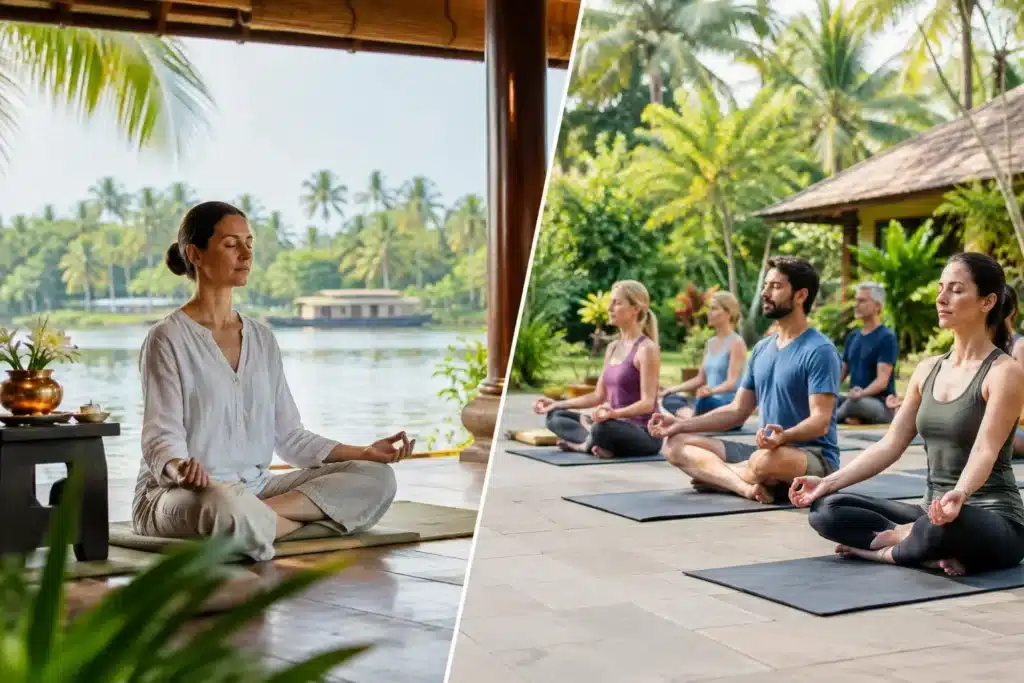
A sunrise yoga practice, nourishing Ayurvedic meals, and time away from daily demands can restore a sense of rhythm. Yet private versus group retreats create distinctly different experiences of that restoration. One offers a deeply personal schedule shaped around your needs; the other brings the warmth, accountability, and shared energy of a small wellness community. Neither is inherently better. The right choice depends on what you need most from your time away.
For international guests traveling to Kerala, the decision also affects the practical shape of the journey: how treatments are scheduled, how much flexibility you have, who you share meals and excursions with, and the kind of support that surrounds you between sessions. Understanding these differences before you book helps you arrive with clear expectations and leave with a retreat experience that feels genuinely yours.
Private Versus Group Retreats: The Essential Difference
A private retreat is designed around an individual, a couple, or a family. Your program may include an Ayurvedic consultation, personalized therapies, yoga, meditation, accommodation, and local experiences, with the daily pace adapted to your intentions and comfort. You are not required to follow a fixed group timetable or participate in communal activities unless you wish to.
A group retreat follows a shared program for a defined number of participants. It may be led by a yoga teacher, wellness coach, or retreat host, with daily classes, meditations, workshops, meals, and selected excursions experienced together. Individual Ayurvedic consultations and treatments can still be included, but the overall flow is shaped by the group schedule.
The distinction is not simply privacy versus sociability. It is about structure, energy, flexibility, and the type of transformation you hope to cultivate.
When a Private Retreat Is the Better Fit
A private retreat can be especially meaningful when your life already feels full of other people’s needs, opinions, and calendars. With fewer external demands, you have room to slow down and pay attention to your own energy. This can be valuable for solo travelers seeking quiet reflection, couples wanting restorative time together, or families who need a wellness holiday that accommodates different ages and interests.
Your wellness plan can follow your pace
The greatest advantage of a private stay is personalization. After an Ayurvedic consultation, the practitioner can recommend a program that aligns with your constitution, current lifestyle, and wellness goals. Treatment timings, yoga intensity, meal preferences, rest periods, and cultural outings can be coordinated with greater care than in a fixed group itinerary.
This does not mean every moment needs to be planned. Often, the luxury lies in having permission to rest. You may prefer a gentle morning yoga session and an unhurried afternoon after an Ayurvedic therapy. Or you may want more active practice, guided meditation, and carefully chosen visits around Kerala. A private format leaves space for both intention and spontaneity.
It offers discretion and emotional breathing room
Some guests feel most at ease when their wellness journey remains private. A first-time Ayurveda traveler may have questions they prefer to discuss one-on-one. Someone navigating a demanding season at work or home may not want the social energy of a group. Privacy can make it easier to settle into new routines without comparison or pressure to participate.
For couples, a private retreat also avoids a common compromise: one person may be drawn to yoga and meditation while the other is more interested in relaxation, Ayurveda, or sightseeing. A customized itinerary can hold both preferences without either guest feeling that they are merely following along.
The trade-off: less built-in community
Solitude can be healing, but it is not right for everyone. A private program requires you to create your own momentum. Although experienced practitioners and a caring retreat team provide guidance, you may miss the encouragement that comes from seeing others arrive for practice each morning or sharing a conversation over dinner.
Private retreats can also feel quieter than some travelers expect. If connection, laughter, and new friendships are central to your idea of renewal, a thoughtfully sized group may be more nourishing.
Why Group Retreats Create Lasting Momentum
A well-led group retreat gives structure to the inner work that travelers often struggle to maintain at home. There is a gentle commitment in showing up for a morning practice when others are waiting beside you. Shared rituals – tea after meditation, meals prepared with care, an evening reflection – can turn a few days away into a more memorable reset.
Group retreats are not about performing wellness. At their best, they create a welcoming container where beginners and experienced practitioners alike can participate at their own level.
Shared experience can deepen the journey
Traveling with a small group removes much of the uncertainty that can come with a solo wellness trip. You have people to meet at the airport transfer, companions for a local excursion, and familiar faces during practice. For guests arriving from the United States, Europe, or elsewhere, that sense of orientation can be particularly reassuring.
Connection often develops naturally rather than through forced sharing. A conversation after yoga may reveal a common reason for being there: stress, a desire for healthier rhythms, curiosity about Ayurveda, or simply the wish to take a meaningful pause. These moments can make a retreat feel less like an escape and more like a supportive turning point.
A skilled leader brings focus
The quality of a group retreat depends greatly on its leadership and organization. An experienced teacher or host sets the tone, making the program feel inclusive rather than demanding. Clear schedules, appropriate class options, reliable transportation, comfortable accommodation, and coordination with qualified Ayurvedic providers allow guests to relax into the experience.
For hosted retreats, local retreat management matters behind the scenes. AyurYoga Retreats coordinates the venue, wellness services, guest logistics, and Kerala experiences so retreat leaders can focus on their participants while guests receive attentive local support.
The trade-off: a shared schedule has limits
Group programs naturally involve compromise. A yoga class begins at a set time. An excursion may appeal to some participants more than others. Individual treatment preferences need to fit within the broader retreat rhythm. If you need complete control over your day, or if your energy fluctuates and you prefer to decide each morning how much to do, a private format may feel more restorative.
It is also worth asking about group size. A small group often preserves a sense of personal attention and calm, while a larger gathering may offer more social variety but less individual flexibility.
Choose Based on Your Intention, Not Just Your Travel Style
It is easy to assume that introverts should choose private retreats and extroverts should choose group programs. In practice, the decision is more nuanced. An outgoing person may need quiet after months of constant engagement. A naturally reserved traveler may thrive with the gentle support of a kind, small group.
Begin by considering the outcome you want. If you are seeking a tailored Ayurveda and yoga program, a slower pace, and uninterrupted time with yourself or a partner, a private retreat is likely to serve you well. If you want renewed motivation, guided daily structure, and meaningful connection with fellow wellness travelers, a group retreat may be the stronger choice.
Your experience level matters too. Beginners sometimes appreciate the reassurance of a group, where they can learn alongside others without needing to know every posture or practice in advance. Others prefer the confidence that comes with private instruction. Experienced practitioners may value a focused teacher-led group, especially when the theme aligns with their interests, or they may choose a personalized retreat to refine their own practice.
Questions to Ask Before You Confirm Your Retreat
Before committing, ask how the retreat handles individual Ayurvedic consultations, whether yoga is adaptable for different levels, and how much free time is built into the program. For a group retreat, learn the expected number of participants, the teaching style, and whether meals, transfers, treatments, and excursions are coordinated as part of the stay.
For a private retreat, ask how the itinerary is personalized and who will guide your wellness plan. It is helpful to share your travel preferences, dietary needs, desired activity level, and any relevant health information honestly before arrival. Qualified providers can then help shape an experience that is appropriate, comfortable, and supportive without making promises that no retreat should make.
Also consider your capacity for travel. Kerala rewards an unhurried approach. Building in time to rest after a long international flight can make the first days of yoga, meditation, and Ayurveda feel far more settling, whether you are arriving independently or joining a group.
The most meaningful retreat is not the one with the fullest schedule or the most complete solitude. It is the one that gives you enough support to soften, enough space to listen, and a rhythm you can carry gently back into everyday life.